
"arabica harvest season"
800 article(s) found

Colombia coffee beans origin flavor grade characteristics story introduction Colombia coffee beans variety brief description
Professional coffee knowledge exchange More coffee bean information Please pay attention to Coffee Workshop (Weixin Official Accounts cafe_style) Colombia Coffee (COLUMBIA) Colombia produces coffee beans accounting for about 12% of the second place in the world. Although the output is not as good as Brazil, the coffee beans are of excellent quality and mostly belong to high altitude.

Introduction to Coffee trees
First, the planting and regional distribution of coffee trees. Botanically, coffee trees belong to the subgenus Rubiaceae, but coffee beans, commonly known as coffee beans, are actually the seeds of the fruit of coffee trees, just because they are shaped like beans, so they are called coffee beans. Climate is the decisive factor for coffee cultivation. Coffee trees are only suitable for growing in the tropics or subtropics, so the latitude between south and north is between 25 degrees.

A brief introduction to the market price of glossy Kenyan boutique coffee beans
Coffee cultivation in Kenya is mainly divided into two types: large farms (Estate) and cooperatives (Cooperatives). The former generally has a large planting area and has independent coffee processing facilities. Most coffee production is done by a large number of small farmers, who form coffee cooperatives. The Coffee Cooperative Society hired special managers to supervise the coffee handling of its members.
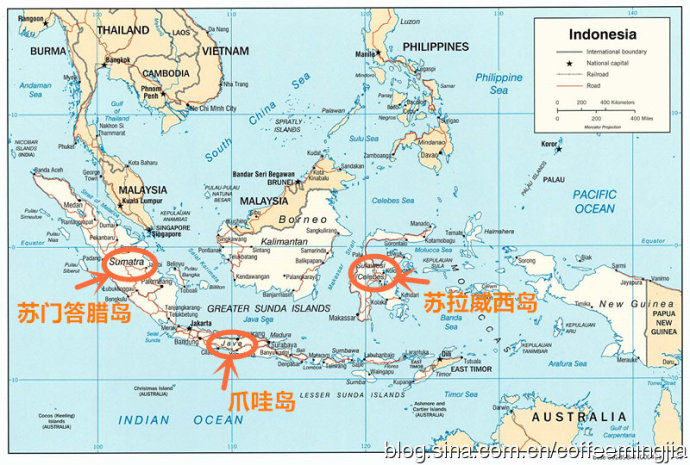
World Coffee Manor production area introduction: detailed introduction of coffee producing country Indonesia Indonesia
Indonesia, the country of Thousand Islands, has the largest number of islands in the world. When it comes to Indonesia, the most familiar is probably the resort island of Bali. A brief History of Coffee in 1696, the Governor of the Netherlands in Malabar, India, gave a batch of coffee seedlings to the Governor of the Netherlands in batavia in Batavia (present-day Jarkata in Jakarta). This was the first time that coffee was grown in Indonesia. But

A brief introduction to the Market Price of Fine Coffee Bean varieties in Kenya
Like the choice of other coffee producing countries, although SL-28 and SL-34 have stood the test of time and cultivated generation after generation of faithful pumps for Kenyan coffee, the Kenyan government and the Coffee Research Institute (Coffee Research Foundation) have begun to promote a new variety, Ruiri 11, for the sake of coffee yield and disease resistance.

A brief introduction to the flavor and aroma characteristics of Kenyan boutique coffee beans
Coffee cultivation in Kenya is mainly divided into two types: large farms (Estate) and cooperatives (Cooperatives). The former generally has a large planting area and has independent coffee processing facilities. Most coffee production is done by a large number of small farmers, who form coffee cooperatives. The Coffee Cooperative Society hired special managers to supervise the coffee handling of its members.
Yunnan small Grain Coffee belongs to Arabica? Yunnan coffee species and flavor and taste characteristics of producing areas
Professional coffee knowledge exchange more coffee bean information please follow the coffee workshop (Wechat official account cafe_style) front street-Yunnan small grain coffee introduction Yunnan coffee cultivation history can be traced back to 1892, large-scale cultivation of coffee is the mid-50th century, but also the first coffee planting base in China

A new coffee producer in the Colombian coffee town is in harvest season.
Angel Maria Orozco, a coffee grower with key cards, uses a pestle to peel off the hard shells of sun-dried coffee beans. Photo: Francesco La Stroch (Francesco Lastrucci) Coffee, however, is not native to Colombia, but it has been grown here for centuries, and the steep mountains are shaded by trees.

A brief introduction to the treatment method of grinding degree and baking degree of spicy and unrestrained Kenyan boutique coffee beans
Large coffee processing farms in Kenya usually have independent processing facilities. A large number of small farmers usually pick ripe coffee fruits by hand. Coffee picking is a labor-intensive job that requires the whole family to deploy and even hire workers during the harvest season. The fresh fruits of the picked coffee need to be promptly transported to the cooperative-owned coffee processing plant for pulping and transportation.

Introduction to the characteristics of Grinding degree in Coffee Bean producing area of Colombia
Colombian coffee beans Colombia is the world's third (and second) coffee producer and exporter, but there is no doubt that Colombia is the world's largest exporter of Arabica coffee and the largest exporter of washed beans. Such a large yield is due to Colombia's unique natural soil and water environment and scientific planting technology. Columby
High-quality coffee beans Arabica VS Robusta
As a crop, tree species and planting environment are the basic factors for the good circulation of coffee beans. At present, the coffee beans in circulation in the coffee market are Arabica (Coffea Arabica) or Robusta (Coffea Robusta). Generally speaking, Arabica coffee trees have fragile vitality, low resistance to diseases and insect pests, and high requirements for planting environment.

A brief introduction to the Market Price of Fruit-flavored Fine Coffee Bean varieties in Kenya
Bourbon Bourbon was first brought to Kenya for planting. In the 1950s, the then agricultural research institution Scott Laboratory selected two excellent hybrids, SL-28 and SL-34, through unremitting efforts, subverting the long-standing prejudice of artificial breeding without excellent natural varieties. SL-28 and SL-34 helped Kenyan Coffee form its own unique

A brief introduction to the cultivation of delicious Kenyan boutique coffee beans, geographical location, climate and altitude
Like the choice of other coffee producing countries, although SL-28 and SL-34 have stood the test of time and cultivated generation after generation of faithful pumps for Kenyan coffee, the Kenyan government and the Coffee Research Institute (Coffee Research Foundation) have begun to promote a new variety, Ruiri 11, for the sake of coffee yield and disease resistance.

Introduction to the basic knowledge of Fine Coffee
First, the planting and regional distribution of coffee trees. Botanically, coffee trees belong to the subgenus Rubiaceae, but coffee beans, commonly known as coffee beans, are actually the seeds of the fruit of coffee trees, just because they are shaped like beans, so they are called coffee beans. Climate is the decisive factor for coffee cultivation. Coffee trees are only suitable for growing in the tropics or subtropics, so the latitude between south and north is between 25 degrees.

Brazilian coffee bean producing areas introduce Minas boutique coffee bean flavor characteristics information Brazilian coffee culture
Professional coffee knowledge exchange for more information about coffee beans, please follow the coffee workshop (Wechat official account cafe_style). They are classified according to the state of origin and the port of transport. Brazil has 21 states and 17 states produce coffee, but seven of them produce the most, accounting for 98% of the country's total output. The terrain of Brazil is mainly divided into two parts, one of which is above 500 meters above sea level.

A brief introduction to the treatment method of grinding degree and baking degree of glossy Kenyan boutique coffee beans
Bourbon Bourbon was first brought to Kenya for planting. In the 1950s, the then agricultural research institution Scott Laboratory selected two excellent hybrids, SL-28 and SL-34, through unremitting efforts, subverting the long-standing prejudice of artificial breeding without excellent natural varieties. SL-28 and SL-34 helped Kenyan Coffee form its own unique

A brief introduction to the Origin, Development, History and Culture of Fruit-flavored Kenyan Fine Coffee beans
Mainly by large farms (Estate) and cooperatives (Cooperatives) two types. The former generally has a large planting area and has independent coffee processing facilities. Most coffee production is done by a large number of small farmers, who form coffee cooperatives. The coffee cooperative society employs special managers to supervise the coffee handling process of its members, even fine enough.

An introduction to the Historical Origin of Ugandan Coffee beans
Following Ka Pai (Wechat official account vdailycom) found that the Beautiful Caf é opened a shop of its own Uganda fact population: 32 million area: 241038 square kilometers location: located in the Great Lakes region of Africa, with Uganda bordering the Democratic Republic of the Congo to the west; North Sudan; Kenya to the east; Lake Victoria, Tanzania and Rwanda to the south. Capital: Kampala official

A brief introduction to the treatment method of grinding degree and baking degree of fruit-flavored Kenyan fine coffee beans
Bourbon Bourbon was first brought to Kenya for planting. In the 1950s, the then agricultural research institution Scott Laboratory selected two excellent hybrids, SL-28 and SL-34, through unremitting efforts, subverting the long-standing prejudice of artificial breeding without excellent natural varieties. SL-28 and SL-34 helped Kenyan Coffee form its own unique

A brief introduction to the cultivation of spicy and unrestrained boutique coffee beans in Kenya, geographical location, climate and altitude
Coffee cultivation in Kenya is mainly divided into two types: large farms (Estate) and cooperatives (Cooperatives). The former generally has a large planting area and has independent coffee processing facilities. Most coffee production is done by a large number of small farmers, who form coffee cooperatives. The Coffee Cooperative Society hired special managers to supervise the coffee handling of its members.